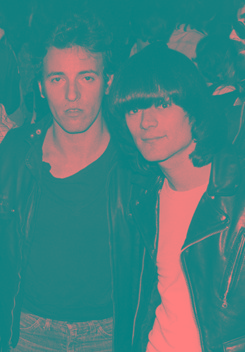
 I had no idea this even ever happened! Sure, I know Bruce originally wrote "Hungry Heart" for the Ramones after he ran into Joey in 1979, but apparently this meeting with Dee Dee happened much earlier, in '77 at fabled Max's Kansas City. The mind it do boggle. Will ever wonder what they talked about...
Monday, February 6, 2012
"Does This Bus Stop at 53rd and 3rd?"
I had no idea this even ever happened! Sure, I know Bruce originally wrote "Hungry Heart" for the Ramones after he ran into Joey in 1979, but apparently this meeting with Dee Dee happened much earlier, in '77 at fabled Max's Kansas City. The mind it do boggle. Will ever wonder what they talked about...

Friday, April 15, 2011



Tuesday, March 15, 2011
More Netflix Instant '70s: Last Embrace, The Manitou, and The Last of Sheila
 Last Embrace (1979, dir. Jonathan Demme) Unavailable on DVD, this suspense thriller plays like minor Hitchcock, complete with obsessive love for a dead woman, a convoluted mystery stuffed with red herrings, a swirling romantic score, and a climactic chase at a national monument (here, Niagara Falls). I sought this one out as a missing piece of Scheider's '70s filmography, and while he's always good - especially his retelling of his wife's accidental death - and his uptight wiriness makes for a perfect kind of spy, I'm not so sure how well he does as a romantic lead. The late Janet Margolin, previously one of Woody Allen's exes in Annie Hall ("Alvy, there are people out there from The New Yorker; My God, what would they think!"), simply isn't femme fatale enough, but damn if she doesn't have one of the most femme-fatale-istic scenes this side of Lady Frankenstein. Chris Walken and Charles Napier show up for some good moments of threat and malevolence as part of the unnamed governmental intel group Scheider works for. But the movie's too vague in the storyline clinches, Demme's direction is busy but unfocused, and overall it leaves you, more than a mystery should, wondering what just happened. Still, if you love Marathon Man, The Conversation, The Parallax View, The Odessa File, and others of that kind, Last Embrace should be an evening's '70s diversion. Especially Scheider's sartorial choices.
 The Manitou (1978, dir. William Girdler) Girdler also helmed '70s trash like Grizzly and Day of the Animals, but it's a disappointment that he gutted the insanely fun Graham Masterton novel, which had all the elements that should have made this film a classic of the era. Tony Curtis is way out of his league, as is Susan Strasberg - yes, of the famous Strasbergs - although I daresay Burgess Meredith knows his way around claptrap of this kind. Campy and junky, it's a mash-up of other occult thrillers of the day but without the novel's sense of tasteless fun. An improbable villain that works well on the page but not really on-screen - that is, a three-foot tall Native American entity known as Misquamacus - the movie never quite feels whole or convincing; it just lies there going through Masterton's motions but not building up the incredible suspension of disbelief necessary. Extra points, though, for the cheap Star Wars ripoff FX at the space-age climax, Curtis referring to the villain as "Mixmaster," and the stupid postscript note as credits roll. You could pass on this, though.
 The Last of Sheila (1973, dir. Herbert Ross... okay, this was on Instant Watch when I first wanted to watch it, but it went back to DVD-only) Now this, this is what I dig in a '70s flick: vintage cast, vintage duds, memorable characters, sharp dialogue, knowing script, effortless direction, and lots of drinking. This is how Hollywood entertains royally. All-teeth movie producer maniac James Coburn wants to settle the score of his wife Sheila's hit-and-run death a year earlier and invites suspects/friends for a Mediterranean cruise on his yacht, named of course Sheila. Who gets the invite? Scorchingly-hot actress Raquel Welch, mustachioed screenwriter Richard Benjamin, stiff director James Mason (complete with nods to Lolita), non-Deadwood-aged Ian McShane (about the time he was squiring Sylvia Kristel; jealous much? Yes); and the charmingly vulgar Dyan Cannon, agent. Coburn sets up a mystery game to be played at different ports where clues must be collected. Except shit starts to get real, and everyone's got a motive. With a stellar screenplay by odd couple Stephen Sondheim and Anthony Perkins, The Last of Sheila is prime '70s film joy; both a spoof and celebration of classic Agatha Christie-style whodunits. Pay close attention to every clue and every quip; not knowing just what the eff happened at the end means, wonderfully, you just have to watch it all over again.
Friday, October 15, 2010
Netflix Instant '70s Horror: 10 Rillington Place, Vampire Circus, and Audrey Rose
 10 Rillington Place (1971, dir. Richard Fleischer) A somber, grim retelling of one of England's most notorious serial killers, played with great and creepy skill by David Attenborough. Disarmingly quiet and deferential, John Christie poses as a former military doctor who now lives with his wife in a terribly run down flat in the terribly run down section of Notting Hill, London, in 1950. The film starts off immediately with that sort of kitchen-sink realism that British cinema practically invented, as Christie murders a young woman by suffocating her. When a young couple, played by John Hurt and Judy Geeson, move into the extra room above the Christies, we know trouble will follow, trouble of the worst kind. Hurt is especially terrific as the illiterate and desperately feeble liar Timothy Evans. Real-life twists and turns make this a rather heartbreaking tale. This is a quietly unsettling and subtle film, the performances and direction are first-rate, and you'll even learn an important fact about British law. It's a little-seen film that is precisely the kind I love to find, one I think folks looking for a true-crime chiller will appreciate this time of year.
 Vampire Circus (1972, dir. Robert Young) A well-known Hammer flick with no US DVD release, I've wanted to see Vampire Circus since I first heard of it in the 1980s. In that time this elusive title's reputation had grown in my mind until I knew my expectation could not be fulfilled. Like a lot of Hammers it starts off with a prologue before the action proper; here, a man watches in shame as his wife offers herself up to a seductive '70s vampire dude. The towns elders converge on the vampire's castle and dispatch him, while the husband is forced to whip his wife as punishment. Or something. Years later, the circus comes to town. The vampire circus. Get it? And they're looking for some payback. The usual Hammer formula - mild T&A, terribly dorky fangs, bad hair for the men - made a bit more interesting by some mild surrealist imagery and a lithe tiger-woman. If you're a Hammer completest, get on board; other folks, stick with Lee and Cushing and Ingrid Pitt.
 Audrey Rose (1977, dir. Robert Wise) I have never been interested in the original novel nor this movie version, but last Friday night I wanted a creepy ghost story and thought this might fit the bill; and if not, at least I'd get some good '70s stylings. I've recently seen a handful of Marsha Mason movies, and really liked her (Only When I Laugh, The Goodbye Girl, and Cinderella Liberty, the last one the best) so Audrey Rose had that going for it too. Sad to say, this film is just one big piece of crappy horror exploitation dressed-up in adult Hollywood clothes. I found it particularly crass in that it markets itself as a spooky creepy-kid movie but in the end simply exploits a child's death for the bullshit feel-good nonsense of reincarnation; it's not a horror film at all. Despite very good performances from Mason and Anthony Hopkins, and even with director Wise, the man behind horror goodies like The Haunting and The Body Snatcher, Audrey Rose is the major failure I always assumed it to be.
Tuesday, June 29, 2010
John Huston's Fat City (1972): Makin' It Through the Night
 Boxing films are never about the sport of boxing. Boxing is so primitive, so stark and simple-minded, that it can only function as a metaphor for the larger concerns of character and conflict. Which is simply fine with me as someone who really has no interest in sports; so many great movies are "about" boxing: Rocky (1976), Raging Bull (1980), Body and Soul (1947), The Harder They Fall (1955), Million Dollar Baby (2004). One film that doesn't get mentioned in the same breath as those is John Huston's 1972 adaptation of a novel by Leonard Gardner, Fat City (1972). Set in the same sort of broken-down loser milieu as a Charles Bukowski story or a Tom Waits song, Fat City has atmosphere and grit to spare.
 vintage '70s paperback
 Vintage Contemporaries paperback
 But it ends badly and he takes to drinking again in earnest. Ernie doesn't do so hot as a boxer, seems more concerned with the cut of his robe than fighting, and soon has to join up with Tully out in the onion fields with migrant workers, discussing marriage. "Ernie, don't let anybody knock marriage," Tully tells him. "No, man, it's got its compensations," Ernie replies. But then Tully, perhaps inspired by Ernie, tries to make a comeback: "I got to get myself together and get down to the gym, start working out..." But this ain't Rocky and the training montage doesn't come together. "I'm gonna be bad news this time around!" He doesn't know the half of it.

 Huston gets all the details right. Filmed in Northern California, the skid-row setting is as rough-hewn, real and powerfully presented as the opening Mexican scenes of his Treasure of the Sierra Madre (1948). You can practically smell the stale liquor and sweat of the characters as they stumble about. In fact, in the opening credits, Keach is sprawled out in boxers and undershirt on his single bed in a dingy room and you'll think you can just reach out and touch the funk. What an intro to a character, especially with the plaintive rasp of Kris Kristofferson singing "Help Me Make It Through the Night" on the soundtrack.
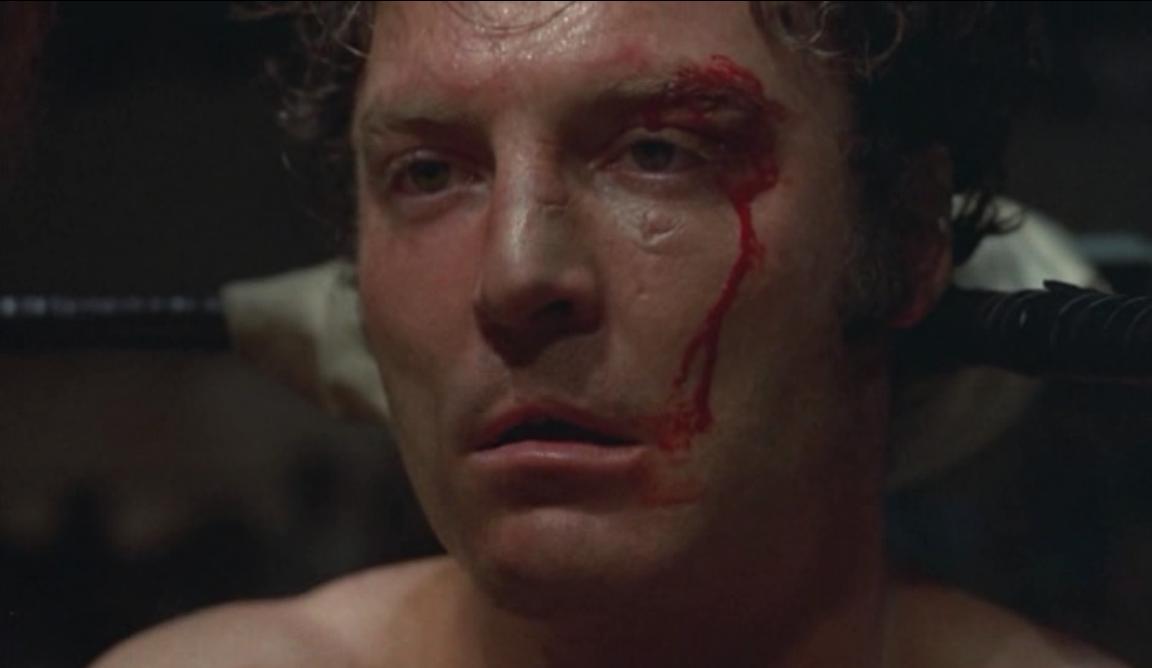 Fat City is one of those forgotten films that deserves a wider audience, filled with scenes that typify the characters studies of the time. Ruben in bed smoking while his wife sleeps, musing aloud about the promise Ernie shows. Ernie and his young wife (Candy Clark) pressuring him to marry while they waste time out parking. A dinner scene with Keach and Tyrell arguing as he opens a can of peas and dumps them on a plate alone is priceless. As Oma, Tyrell is truly one of the great screen drunks, slurring, screeching, stumbling, taking offense at the slightest comment one moment, petulant and self-pitying as a child the next. She's almost unwatchable, which might be the point.
 And when it all wraps up, after all the ups and downs and drunken confrontations have been experienced, there is a truly honest and touching, even awkward, moment. Tully and Ernie randomly meet up one night - Tully's drunk, Ernie's given it up for his family - and get a cup of coffee in a truly desolate coffee shop, served by an ancient Asian man. Tully muses, "The waste... Before you can get rollin', your life makes a beeline for the drain." Kristofferson's song sneaks up on us on us again and we're left to wonder if indeed guys like this can make it at all.
Sunday, June 20, 2010
Jaws: On a 35-Year-Old Obsession
 June 20th, 2010 marks the 35th anniversary of the release of the movie JAWS. This post is part of Radiation-Scarred Review's 2010 SHARKATHALON, which celebrates this milestone with blog posts around the web.
 "There is a creature alive today that has survived millions of years of evolution. Without change, without passion, and without logic. It lives to kill. A mindless eating machine, it will attack and devour anything. It is as if God... created the devil... and gave him... Jaws." - Narration from the original 1975 trailer.
 Where does an obsessive fan of Jaws even start? How does one trace the threads of its power to captivate, to enthrall, to terrify? What does one make of its entwining itself throughout a life, and especially the nightmares, the nightmares of monstrous, maniacally grinning sharks that look like nothing ever seen on earth? One starts at the beginning, one supposes.
 Being exposed to it from the age of four is probably the main fact of it. Growing up in the 1970s, you couldn't escape the Jaws phenomenon, even if your folks wouldn't let you see it until you were older. So you spent a lot of time being accosted by this monstrous shark image and wondering if, when you finally saw the movie, you'd die of fright. And by you I mean me, of course. The week before I saw it on re-release in 1978 or '79 (at a drive-in, no less!), I laid awake in bed each night, literally fearful for my life. Would this be the last thing I ever saw?
 One of my earliest memories is of my parents picking my sister and me up from our aunt's house, who'd babysat us while they went to see the movie in '75. From the darkened backseat of the car I asked, "How'd they kill the shark?" My mom replied, "Three men went out on a boat and blew it up." In my tiny head I had an image of three men in a wooden fishing boat throwing a stick of dynamite into the ocean while a rather large nondescript fish swam beneath them.
 me, c. 1976
Also a kid I spent a lot of summers down at the Jersey Shore so there was plenty of time to ruminate upon just what lurked beneath the waters. Daytime was bad enough, of course, but night was worse. Hearing the endless roar of waves and looking out over a blackened sea and imagining what was beneath - imaging myself out in those waters, helpless and alone, truly vulnerable, as swells lifted and dropped me, pushing me further and further from shore - was almost too much for my imagination.
 I'd lean over the boardwalk railings and give myself a frisson of delicious terror, like someone who craves the burn of whiskey or habaneros on their palate. Then my parents would call me to catch up and off I'd run, glad to be free of the fear that I know haunts people everywhere; even, I'm sure, in landlocked places. I even remember being afraid of swimming across a pool at night, when I was older, and giving myself that same tease of terror... and then getting out, drying off, going inside.
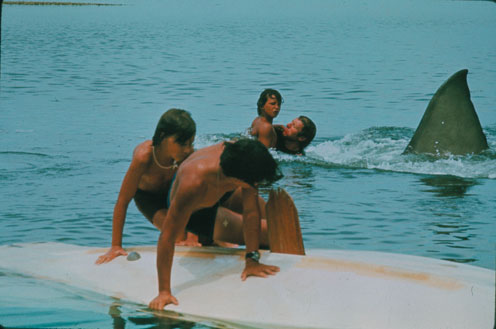 The estuary sequence as originally shot
But Jaws is more than just cheap thrills, and while I always watched it over and over whenever it was on TV, it's been in the last three or four years that the obsession has fully bloomed. Once I had the DVD it was on almost nightly. Now that I'm an experienced film fan, with a film degree and all that entails (basically writing about films for free online), watching Jaws is a different experience; the pleasures are not simply in the terror the movie engenders, but in how that tale is told. It is common film lore that the shark didn't work so the filmmakers couldn't use it as much as envisioned, etc., etc.
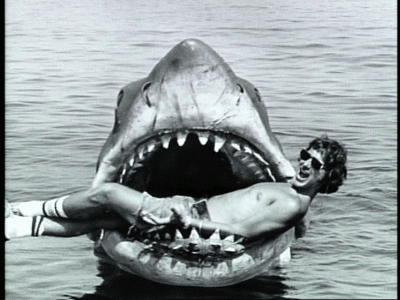 Today I see how perfectly the film is constructed, how effortlessly it presents character and dramatic conflict, how it takes its time getting to the "good stuff." Like all great '70s movies there is overlapping dialogue, faces that bear the traces of lives lived and not makeup artists employed, and space, so much space for which the characters to move in and around, a real sense of place... until we get to sea, of course, and all avenues are closed off. It's man versus nature and man versus man and man versus himself. Brody, Quint, and Hooper each have their own reasons for confronting this beast. Scheider, Shaw, and Dreyfuss are one of the great cinematic ensemble casts. Watch each actor closely next time you see the film; you'll be amazed at the little things they do to solidify their characters.
 Do I think that Jaws is the best movie ever? Honestly, in many ways, yes, I do. It is surely the finest thriller Hollywood has made; in its perfect cocktail of character and carnage it is still a beacon to filmmakers today. While other favorite movies of mine may aspire to a higher, more rarefied art, I am also of the opinion that art and generic conventions need never be separated and yield some of the finest films ever made. The Godfather could have been a cheap gangster flick; The Silence of the Lambs a potboiler about a mad doctor; Raging Bull just another sports triumph movie. But they're not, and neither is Jaws simply another monster-on-the-loose story. I'm surprised when I talk with people who think so.
And then once in a video store I overheard a young woman whining to her boyfriend, "Why is Jaws in the horror section?" Took all my strength to not grab her, thrash her about, and shout in her face, "Because when a shark EATS YOU it's considered SCARY."
 "Hello, Universal? Look, I know I'm only 26 years old, but I'm gonna make you the first movie to ever gross $100 million ever. What? You want me to shoot it in a tank? FUCK YOU."
Jaws could have been what all of its countless imitators are: cheap and fast, Corman-style exploitation flicks with all of the blood but none of the heart to give it a beat worthwhile. We've all seen those movies and we've all thought they were... okay. But Steven Spielberg's Jaws (and, of course, Benchely's and Scheider's and Dreyfuss's and Shaw's and Verna Fields's and John Williams's), even with its gore-flecked teeth and gaping maw and insatiate hunger, with the irrational fear it has given people all over the world, again I say that Spielberg's Jaws is heart, all heart, and probably even my own.
Cheers, and thanks for reading.
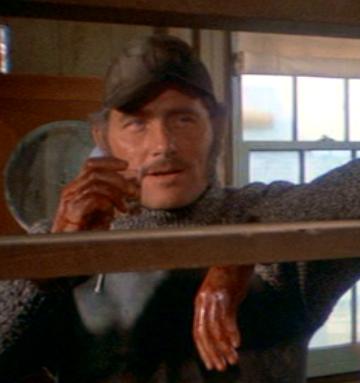 "Here's to swimmin' with bow-legged women."
The second most famous toast in film.
Subscribe to:
Posts (Atom)




.jpg)


